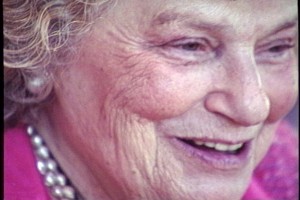

Tales of Viola Spolin:
The Zen of Theater Games
I was living in Hollywood, tending bar,
performing comedy and mime in local cafes and trying to break into show
business like thousands of other hopefuls from all over the country.
A dear friend of mine called from Potsdam University. He told me he was
doing a paper on Viola Spolin, the author of “Improvisation for the
Theater” the basic handbook of improvisation. He said that Viola Spolin had
a center in Hollywood and would I go and check it out and get him some
information.
Why
I had never heard of this woman? Her name was never mentioned in any of the
professional improv workshops I attended in LA. If she invented this form why
don’t people involved in the profession give her credit?
I
began studying improv in 1976. I came to LA and began workshopping with a
group called “Off the Wall” (still performing). They were a very funny and
quick bunch. It was fun, fast paced and very nerve wracking for me. We did
Freeze Tag and other funny character scenes. I’d try my damndest to wing it
and look for opportunities to insert my humor and wit. Although I had fun and
felt it was worthwhile, it was very much like taking a fencing class filled
with tension. All the players in this workshop viewed each other with a
sort-of friendly competition. We were a group of people who had developed
various ways of being funny and sort of sparred with each other. To my credit,
I was able to hold my own among these very fast witted and funny people.
I
found myself outside the Pilot Theater on Santa Monica Blvd., asking if there
was any information on this Viola Spolin. A former student of hers was
conducting the workshops on her behalf and told me I’d get more information
by taking a workshop with him. I agreed and began attending this workshop. The
difference between this kind of improvising and the comedy improv I had been
doing was amazing. The games we played were not played for laughs, yet
laughter was always a part of the workshop. It was fun and a relief from the
pressure of having to be funny. I enjoyed it a lot.
One
day, Viola Spolin came by to watch this former student teach the workshop. She
was in her late 60’s. She had steel gray curly hair, wore jade oriental
earrings and some nice bohemian print dress. Her student led some exercises
with us and before we got too far, Viola stood up and said to this guy, “Get
out! You don’t know what you’re doing.” We were thunderstruck and
totally ignorant of whatever she saw as the failure in his approach. In any
event, she dismissed him on the spot and he left. She then turned and faced us
and announced that she would take over and start from the beginning.
So
we began again, this time with Viola Spolin herself!
The
first exercise was the mirror - one that I had done many times before.
However, she coached us into the mirror urging us to “follow the follower”
- where no one is leading and both are following. I knew the sidecoach phrase
‘Follow the Follower” and I thought I had an understanding of it but, I
had never been coached like this. Viola’s coaching seemed to keep me
constantly off-balance. I didn’t seem to have a chance to copy the movements
of my partner. Yet I was doing the movements. Viola’s timing and other
comments began to have an effect on me that I had never experienced. I started
to loose control. I began to tremble. The harder I fought to accomplish the
mirror the more I trembled. Viola yelled into my ear, “Follow the
follower!” “Let it flow!” “Let it Flow!”
I
really was shaking now. It was a vibration like trying to hold a jet in flight
while crashing. The harder I yanked on the stick to gain control, the more I
shook. Eventually she called the exercise to an end and released me from this
condition. I was ‘shaken’, literally. I sat there dazed. Viola came up
behind me put her hand on my shoulder and addressed the class. “Now you see,
this young man here had a direct experience.
He actually got to see Marty.” (The woman I did the mirror with). She went
on “I would guess it was the first time he ever really saw anyone in his
entire life.” She went on to other exercises.
I
knew she was right. I had been in my head.
My life was dedicated to making quick judgments about everything and
everybody. I had become very good at filtering quickly, all the behavior and
awareness I needed to interact with people. I was good at it. I was quick. I
had the ability to integrate all my opinions and judgments into funny lines
and moves. I could assess situations in the blink of an eye. I felt safe and
well protected with this ability. In fact I thought Improv was the perfecting
of this talent.
This
was different: As I beheld my partner, I had no opinion of Marty or saw her as
pretty or talented or thought to myself anything while I was with her in this
mirror game. I was just there and she was there. I had never been so exposed
or exhilarated and I knew I had found something profound. I was on the verge
of “follow the follower” and, although I tried with every fiber of my
being to achieve the focus, I couldn't. This caused the ‘shaking’ I knew I needed to
explore this.
At
the end of the workshop, I hung around. Viola was standing at a table, sorting
through her theater game cards and making some notes. I came up to her and
respectfully said, “I want to thank you…”
“DON’T
THANK ME!” she yelled. She whirled on me. “Don’t thank me! Don’t you
see it’s not ME? It’s not me. It’s the work! I didn’t do anything…
it's, it's --- Oh, get out!” It appeared she was on the verge of a lecture and then thought
better of it. She stopped; and as suddenly as this outburst emerged, it
subsided. She turned back to her cards and notes.
Luckily,
I was raised by parents who were ‘yellers’, so her outburst appeared to me
as concern and a caring reaction. I somehow knew her don’t thank me
response meant she didn’t want her ego stroked or to be treated like some
guru. She was fearful of flattery and she shut it down whenever possible.
Later she would tell me flattery is the tool of approval seekers, and
the approval/disapproval syndrome,
prevalent in our culture, was her constant nemesis.
“I
want to be your apprentice.” I said. Well, that stopped her. She turned from
her notes and looked at me with a kind smile. She took off her large gray
glasses and looked at me with her watery blue eyes. “Oh honey, you don’t
know what you’re talking about.” I stood there resolute.
“Let
me tell you a story.” She began. “About the young monk and the master. A
young monk came to the master and asked ‘how does one become a master?’
The master said he would allow the monk to stay and learn. On one condition
– ask no questions except for once a year. Also, the monk had to agree to
tend the master’s hearth and home. The monk agreed. One year passed and the
monk tended the fire and cooked the meals. ‘Master it is time to ask the
question.’ ‘Ask’ said the Master. ‘How does one become a master?’
The Master said ‘Be sure to wipe your feet after you clean the hearth.’
That was all the answer the young monk got. The years went by-- Each year the
same. ‘How does one become a master?’ ‘You missed a spot when you
cleaned the wall, don’t let that happen again.’ Or ‘Make sure you get
all the spots on the windows when you clean them.’ The monk had to be
content with these answers.” she said.
“Ten
years go by.” She continued. “The monk was walking up the stone steps
carrying a yoke of water. You know, a bar with a bucket on each end. And he
said it was time to ask the question. ‘Go ahead and ask’ said the Master.
‘How do I become a master?’ The Master said, ‘be careful not to dip your
shoulder so low coming up the steps, you’ll spill the water.’ AND IN THAT
INSTANT…” she snapped her fingers and leaned closer to me “He became the
Master!” Silence.
Then she said, “So you see honey, you don’t really know what
you’re talking about.” She
gathered up her notes and left me to ponder that obtuse story.
I
came to class every week and early on, I was by no means a very good player. I
was in my head a lot of the time. I tried desperately to figure out what she
wanted me to do. In fact, I left many times deflated and frustrated. She never
said we were good or bad. She just pointed out that when a game doesn’t work
it’s because we are in our head. We played hundreds of games. Our workshop
group knitted into a wonderful bunch of players. She laughed a lot, yelled a
lot and launched into occasional tirades that could be very stinging, but I
knew that her frustration was over the fact that we didn't achieve that fragile,
present-time-direct experience that she was always after.
Viola
found out I lived only several blocks away from her. She asked if I could
drive her to and from workshop. I did. She also found out I liked to cook. Her
father was a wonderful cook and she told me stories of great family dinners
where her father would serve up amazing dishes from the old country. I would
get a call from her occasionally asking me if I was going shopping at Hughes
Market, the local grocery, and would I mind getting her a cabbage or some such
item. I did.
In
workshop, she’d sometimes ask me to take down what games she played. I
should note here, that Viola had a standing rule she made very clear to all
her students. No note taking. “If you can’t walk out with it in
your bones, it’s not going to do you a bit of good on a piece of paper.”
She would say. Actually, her vehemence stemmed from other teachers coming in
and observing her work, writing it down and calling it their own. She once
told me when she was working on her transformation exercises; a well-known
director came in to watch several sessions. Soon after he became very famous
for using it as the basis of a theater style he claimed to have invented. He
never gave any credit to Spolin’s work as the source material. This
infuriated Viola and made her forever wary of what she called ‘predators’
in the theater.
By
this time everyone in her workshop was well aware of her temper and most were,
frankly, afraid of it.
During
one class, I sat with a notebook dutifully making notes of what games she was
using and referencing. She was on the stage, pacing around and lecturing when
she looked up at me in the audience and saw me taking notes. “GARY!!” she
yelled. “YOU! OF ALL PEOPLE! How dare you take notes in my workshop!”
The
rest of the class visibly hunkered down, in a way, trying to duck her wrath.
“Godammit, Viola, you told me to write down the games you’re
doing!” I hollered back.
“Oh,
yes. Right.” She said and went right back to her lecture.
That
day, after workshop, I drove her home. She asked if I’d like to come in and
have a glass of vodka with her. We came down a stairway into her hobbit-like
house perched in the hillside of the Cahuenga pass in the Hollywood hills. It
was originally a goat shed in the early thirties and had evolved, over time,
into a wonderful pastiche of modern woodwork and beams and smacked of the
bohemian 60’s with its patchwork of wood, wall hangings, blue glass and
pottery.
I watched her go through the house looking under
pillows, behind clocks and pictures until she found a Camel cigarette.
“I’m trying to quit, so Kolmus (her husband) hides a few around the house,
I have to find one if I want a smoke, so I’ll cut down. It works.” She invented
a game to quit smoking! We had a glass of vodka and that was that. I made the
leap from student to friend.
Thus
began my apprenticeship. I brought her groceries, drove her to and from
workshops, cooked many meals for her and her husband, catered several parties
and sat by her side as she led workshops. I asked several times if I could
begin teaching what I was learning. “No!” she snapped.
I felt her refusal was because she feared the ‘predator’ in me:
That my request to teach was ego driven: That I would be like so many other
students who hung out shingles as teachers after a few months in her workshop,
before thoroughly understanding her philosophy. Somehow, I understood this.
She would change the subject. “Say, if you go by Hughes market, pick me up
some potatoes.”
Back
at workshop, she would call out sidecoaches during scenes and when they worked
she’d lean over to me and say, “you see how that freed him up?” or
“now he’s got the focus” or just plain, “There, you see?” Sometimes
she would yell “NOOOOO! Not like that!” her temper often getting the
better of her. Once, I watched as she yelled out some sidecoach very loudly to
a young actor. He absolutely froze. He continued in the scene in a very herky-jerky
fashion, totally stifled by her yelling. I pointed it out to Viola. She patted
my arm and said “Thank you dear.” She went down onto the playing area and
calmly announced that she is aware that her yelling has an adverse effect on
some players.
“That’s
your approval/disapproval syndrome. But it’s only my passion!” she boomed.
“Still, I’ll find a way for you to work with me.” She did not want to
stifle her instincts (and yelling was instinctive to her), so whenever she
became aware that her raised voice frightened a player she would temper it
with “NOOOO! Not like that!!!… She declared!” Or “Use your
where! … She hollered!” This took the fear of her anger away and
reminded us that it was her passion that caused her temper to flare. She was
always looking for ways to be true to her own instincts but primary was her
desire to get us to use her sidecoaches and get out of our heads and into the
space.
After
eight years, my desire to teach theater games was still strong. I was teaching
and performing Mime during this time, but soon found it too mechanical and
boring. I always enjoyed teaching. Originally, I taught for the sake of my
ego. I taught by rote. I knew something you didn’t and I was special.
I liked being looked up to and respected and having some small power
over others. This was now so tedious to me.
“Teaching”
Viola would say “is a cleansing. You have to solve a problem. Students give
you problems in their resistance or lack of focus. You play every game and ask
yourself, what will get them out of their heads?”
I understood sidecoaches are prompts within the playing of the game.
During each game, if the players aren't playing well, that presents a problem
to the sidecoach. The players are dealing with the problem of the game. You
are there as a sidecoach to solve the
problems of the players to help them solve the problem of the game. ‘Cleanse yourself of the past – rote way to do the game and be
in the moment with your player.’ I adopted that attitude and ever since,
teaching has been endlessly rejuvenating for me, and a source of great
satisfaction.
Eventually,
Viola permitted me to teach children’s classes and show the games using
space object work to my fellow mimes. She would watch me teach and later, over
a drink, ask me questions about my students and what problems they presented.
She never gave me outright advice on how to teach, though, other than to say,
“If you have a problem, there’s a game to solve it. And if there isn’t a
game, invent one.”
I
began to have many successes in my own acting and performance work. Sometimes
in class, after I had achieved some focus that may have eluded me she would
offhandedly ask, “Do you realize you had a breakthrough
there?” I would nod. There was never a comment like ‘well done’ or
‘good work’, and I knew enough never to say “Thank you” to her. My
career as an actor and performer progressed. Viola’s coaching and the games
were a major reason.
The
years passed and I continued to study with Viola and assist her in various
workshops. Our friendship grew. I
met my wife, Tina at Viola’s 75th birthday party (which I catered
by the way). We married two years later on November 7th –
Viola’s birthday. The next year we had a party celebrating Viola’s
birthday and our anniversary. (My wife and I catered it, of course) The party
was wonderful, as were all of Viola’s parties. Towards the end of the night,
I was cleaning up ashtrays and gathering glasses. Viola was sitting in the living room.
Tina was in the kitchen washing dishes. I poured a brandy for Viola and myself
and sat down. “Viola, do you remember the first day we met?”
“No.”
She said
“I
do.” I said. “You yelled at me for thanking you and then, when I asked if
I could be your apprentice you told me a story.”
“Oh?”
She smiled.
“You
told me a story about a young monk who went to the master to
ask how to become a Master?”
“Yes,
yes. I know that story.” She said.
“Well Viola, I’ve driven you back and forth to workshops for last ten years.
I’ve gone shopping for you and cooked you meals. Here we are, Tina and I,
cleaning up your house after a great party. So I have only one question – How
the hell does one become a Master?” Viola howled with laughter.
“OK, you’re the Master.” She laughed.
I
absorbed Viola’s philosophy and way of working without her ever telling me
“how”. She told me a lot of things, but never “How to do it.” Her work
is predicated on not telling ‘how to.’ Her goal was to replace
authoritarianism
with a more enlightened view of education.
She aimed at conceiving of and presenting techniques to discover the
how on your own. When you solve a problem on your own, it’s yours. Then
you own the discovery and can integrate it in your own life.
Yet
this ownership of insights gained is, in fact, a trap for the ego: The very
thing that she teaches so easily allows the ‘predators’ to understand and
write the “How to” books and appear so smart and perceptive.
It’s
very tempting to want the prestige that comes with being an authority. It is
highly seductive. Especially when you actually feel that you came by this
enlightenment on your own. It is
all too common in our culture and perpetuates reliance on authority -- the
accepted way we understand learning. Autonomy becomes a revolt against a
teacher instead of a gift from a teacher.
It
takes true humility for teachers/authorities to understand and acknowledge
that there is a source, other than the teacher, from which you draw. It is very rare, for we are not a
humble culture.
I
fear this leads to the loss of integrity we see everywhere in our society --
The acceptance of cheating, the erosion of morality, and the search for fame
for fame’s sake. Celebrity is an accomplishment rather than a byproduct of
accomplishment. We revere this behavior.
Taking
credit not due you is too common. It is the building block of reputation,
which is legal tender in our culture. A trap.
“How
to” is an accepted shortcut to learning. But it really isn’t. It
shortchanges us and dampens our own will to freely, playfully explore,
discover and learn. We all want to learn “how to” but asking how or being
shown keeps us in our heads and makes us follow-the-leader -- not
follow-the-follower.
Solving
problems on your own with an experienced eye to support you develops your
talent and personal genius. Viola knew this. Put your focus on simple things -
like games. State the rules and play, and all life’s lessons can be learned.
But,
how can we do it?
“Be
sure to wipe your feet after you clean the hearth. --
‘You
missed a spot there.’ -- ‘Be careful not to dip your shoulder so
low -- you’ll spill the water.’
That
is the way to mastery and when it comes to improvisation. Viola Spolin was the
master and deserves the credit for it.
In
closing, despite her protestations: I have to say, “Thank you, Viola.”
---- Gary
Schwartz, March 2001 North Bend, WA
E-Mail at
ils@spolin.com